Appendix: Life of a Dram
This appendix is an overview of the whisky process from beginning to end. It’s intended to give context to my blog post about my week in Springbank’s Whisky School.
There are a heckton of sources of this information upon the internets, but after my week at Springbank I was for a brief, shining moment able to remember what all the weird terms of art — “mash,” “malt,” “wash,” “wort,” “feints,” “low wines,” etc. — meant, and I wanted to write it down before it faded from my brain.
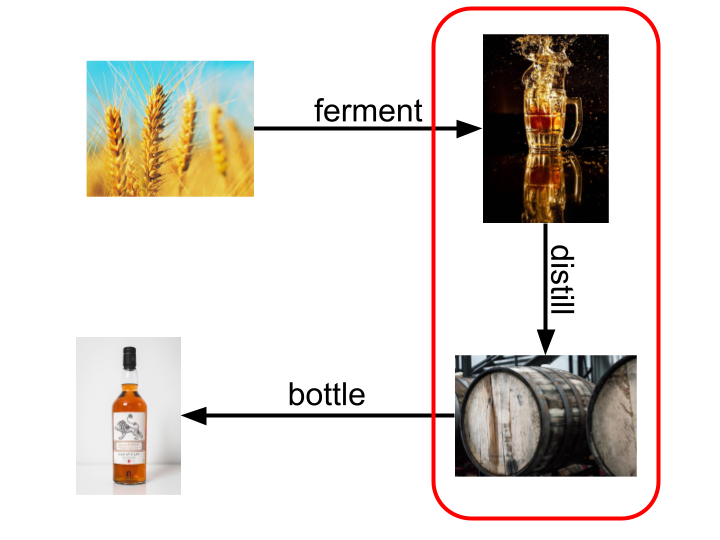
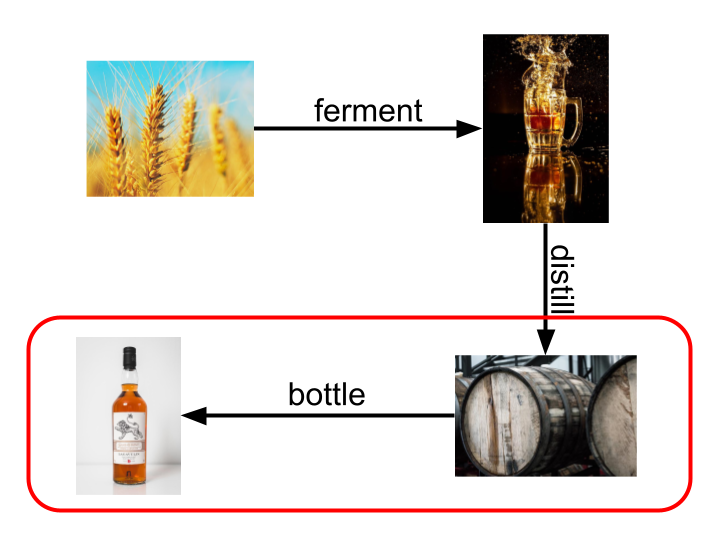
The process, simplified: whisky is distilled beer
Most explanations of distillation are “complexity first” — they go through every detail and every weird term of art, in chronological order of the process. I personally find it more useful to start with a high level model, understand that, and then delve into more detail from that framework.
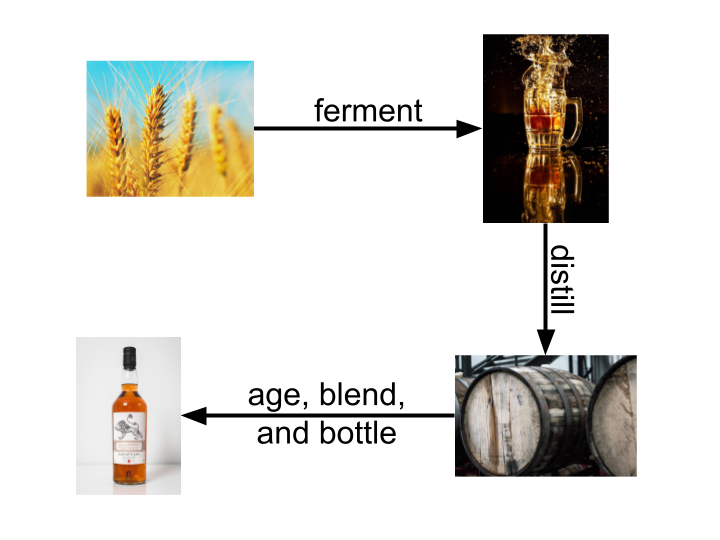
- Make barley into beer (fermentation).
- Evaporate the alcohol out of the beer and put it in wooden casks (distillation and barreling).
- The casks age, and then the contents of one or more casks are blended and poured into bottles.
The process, complexified
Scotch production is an old industry and has lots of very specific and non-obvious terms (e.g. the beer is called “wash”).
Springbank prides themselves on being the most traditional, most manual Scotch distillery left.
The details below (particularly the numbers) are specific to Springbank’s whiskies. Every distillery does something similar, but many use automation or outsourcing (e.g. it’s common for a single malting plant to supply many distilleries), and the time in kiln, number of distillation steps, etc. will vary.
Making the wash (beer)
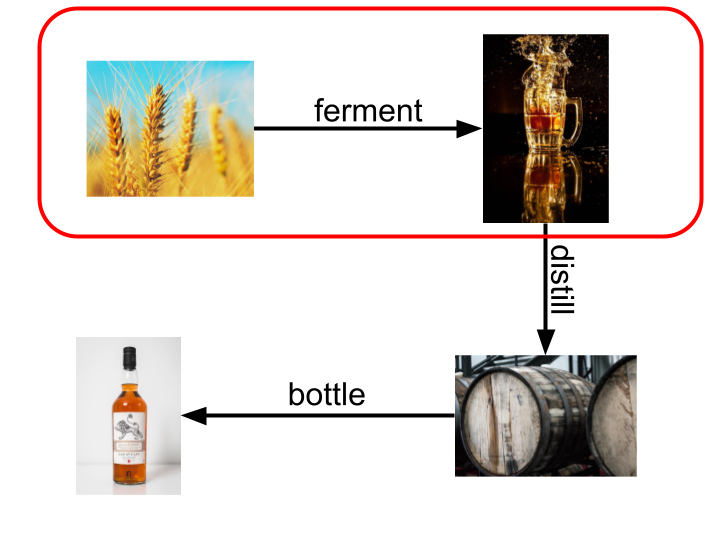
Fermentation is the process of convincing yeast (which is a fungus, neither animal nor plant) to ingest sugar and excrete alcohol. For whisky, the sugar comes from grain (Scotch whisky uses barley almost exclusively, but other kinds of whisky use other grains), and this phase of the process is all about bringing the sugar of the barley out into a form where the yeast can do its thing.
The barley grain is sprouted (which causes more sugar to come out), a process called malting. The sprouted barley is kilned (roasted at high temperature) to arrest the growth process and convert the sugar to a more accessible form. It’s milled in a grinder to extract the most sugar-rich cores of the grains; then it’s mashed , which means it’s soaked in water to extract the sugars (and some grain flavor). The resulting sugary liquid (the wort) is then fed to yeast, who ferment it into an alcoholic mixture called the wash , which is, chemically, beer.
Malting: coaxing the grain into sprouting
When grain sprouts (or “germinates”), it releases enzymes that converts the barley’s starches into sugars.
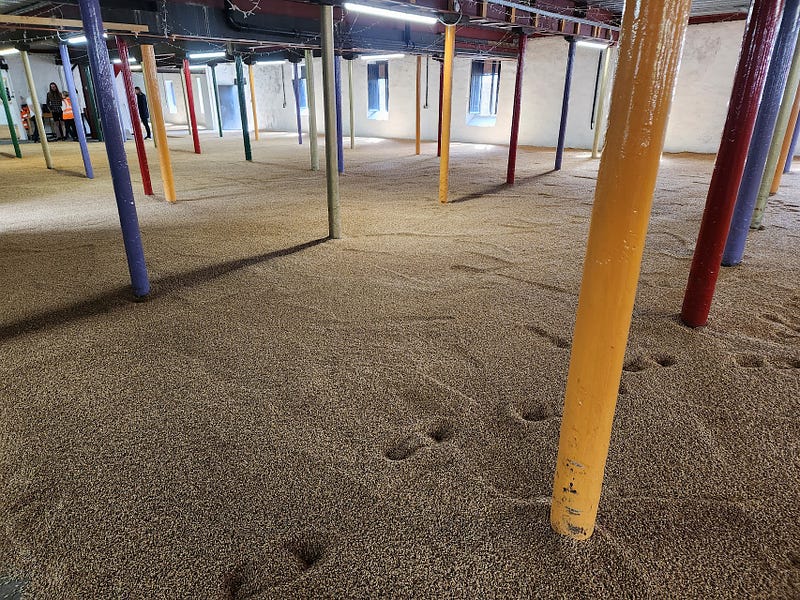
- Barley is purchased; it starts out at about 15%-25% moisture by weight; it’s stored in 30 ton storage bins where it dries to 12% moisture.
- It’s moved into the steeping bin in batches of 10–12 tons (“tonnes,” if you insist), and stays there 42 hours, during which it goes through multiple cycles of steeping (soaking in water) and draining.
- It’s spread over the malting floor and allowed to dry and to sprout.
- It’s raked (turned and grubbed) at regular intervals, so that tendrils of sprouts don’t knit together and turn it into mats (which would have to be destroyed).
- It’s poured through a hole in the floor into a room with a grill for a floor and a fire underneath, called the kiln.
Kilning: drying the grain
Drying the grain stops it from sprouting any further, keeping it stable and arresting it at that specific phase of sugariness. It can be dried either with hot air, which just dries it, or with peat, which both dries it and leaves it with a smoky flavor.
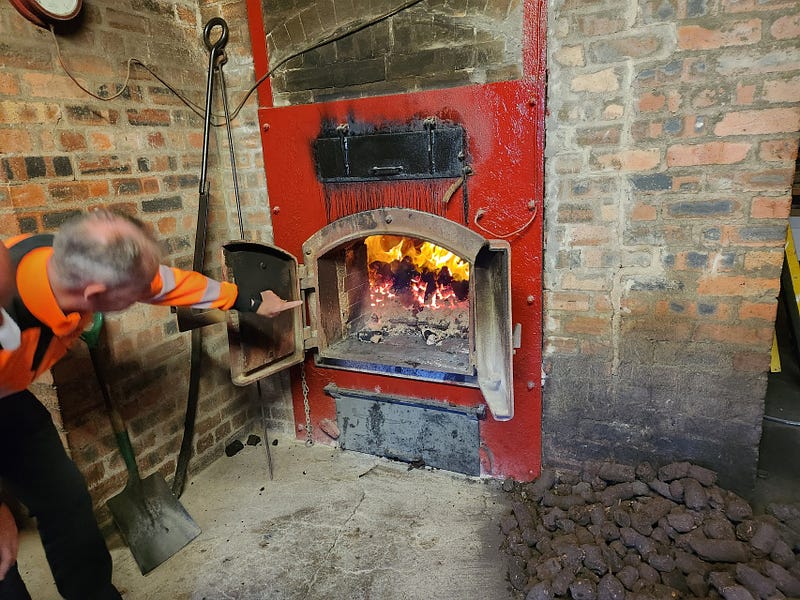
- The grain is dried in the kiln through a combination of burnt peat (partially decomposed vegetable matter, on the way to becoming coal) and hot air. How much peat smoke vs. hot air depends on the type of whisky. The kilning takes 30–48 hours. (E.g. Hazelburn has no peat, only hot air; Springbank gets 8 hours of peat and 30 hours of hot air; Longrow gets 48 hours of peat.)
- For recipes that include peat, someone shovels peat into the fire, sometimes in shifts for up to 48 hours.
- Once kilned, dried grain is transferred to storage called the malting bins.
Milling: grinding down the grain
The outer surface of the grain is tough and low in sugar, so it’s not useful to the fermentation process. Milling strips it away, leaving only the sugary interior.
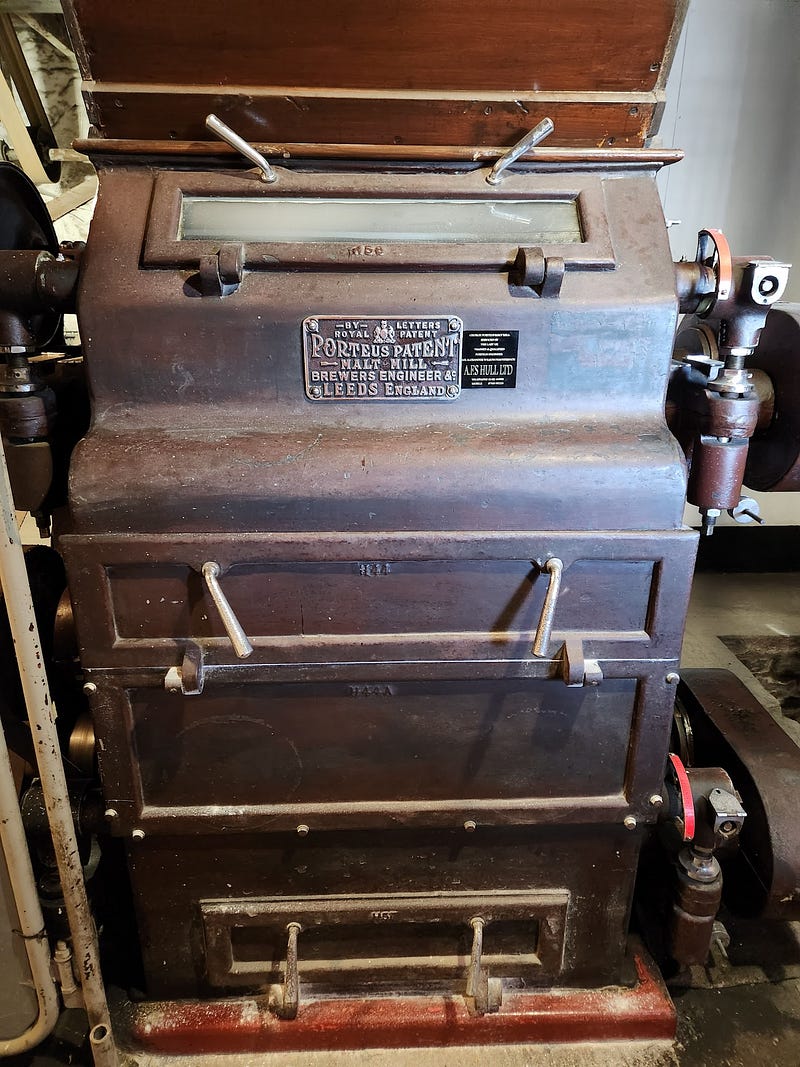
- A batch (called a mash) of about 3.4 tons of kiln-dried barley is transferred from the malting bins into a mill.
- The mill grinds the grains down, discarding husks and flour , and transferring the remaining middles into the grist bin.
Mashing: soaking sugar out of the grain
Up till now, we’ve been dealing with solids. Mashing is when we extract the grainy, sugary goodness we’ve been building into a liquid, by soaking, heating, and stirring.
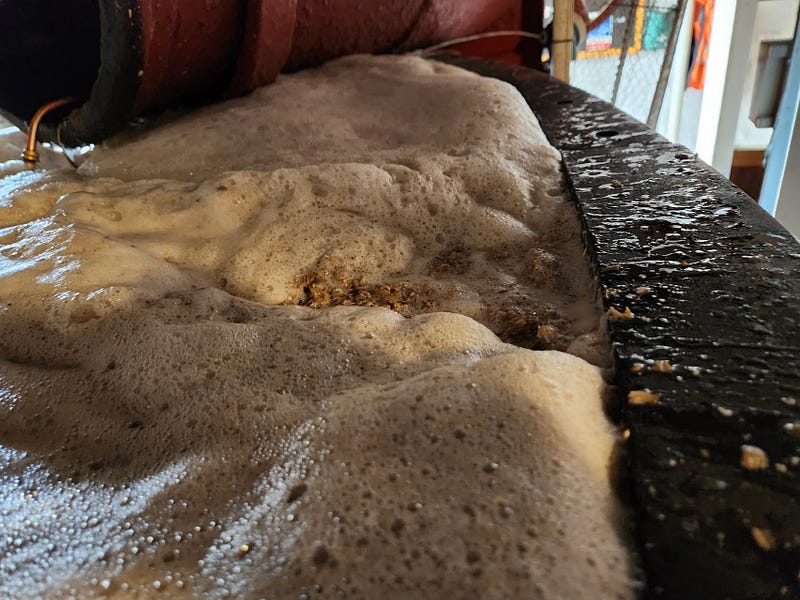
- The mash is transferred from the grist bin into a large metal vessel called a malt tun.
- It’s soaked in hot water; the water extracts sugars and becomes a mixture called wort.
- The wort is drained out, and the soaking/draining process is repeated a few times at higher and higher temperatures to extract more of the sugars.
- The grain left over at the end is called draff. It’s shipped to farms, to feed non-sweet-toothed animals.
Fermentation
And now the yeast chows down on its favorite, sugar, and spits out alcohol as a by-product.
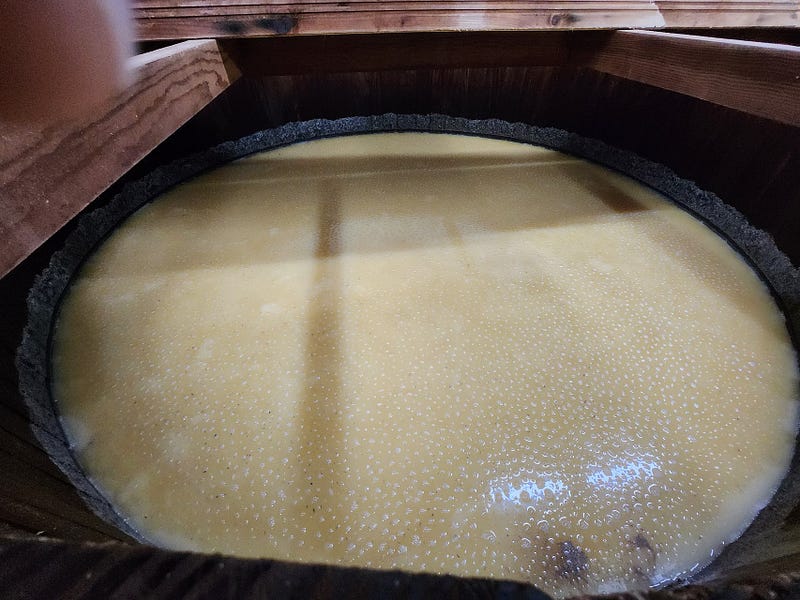
- The wort is transferred to wooden (for Springbank, though many distilleries use steel) vessels called washbacks.
- Yeast is added, to eat sugar and excrete alcohol. This fermentation continues for several days.
- At the conclusion of this process, the washback is full of beer, which in the whisky process is called wash. (The wash doesn’t usually contain hops, because they’re a preservative and the distillation will serve that function, but there are plenty of beers with no hops.) Springbank’s wash is about 6% alcohol by volume.
Distillation
Distillation is the process of converting a lower alcohol beverage into a higher alcohol beverage by boiling out the alcohol, capturing the alcohol vapor, and condensing it back into a liquid. (At the beginning of the condensation, the chemical composition is less palatable, and these heads are filtered out; the same is true of the end, with the tails.) This process can be (and is) repeated. Every repetition increases the alcohol percentage, but pure alcohol is flavorless; each iteration of distillation leaves behind some flavor. So it’s done a limited number of times, and the exact number is part of the “recipe” of a given type of whisky.
Running the stills
- A liquid is transferred from the previous stage (either the washbacks, or a previous still) into a vessel called a charger.
- The liquid from the charger is transferred into the still.
- The still is heated to the boiling point of alcohol, which makes alcohol evaporate out of the liquid into the condenser.
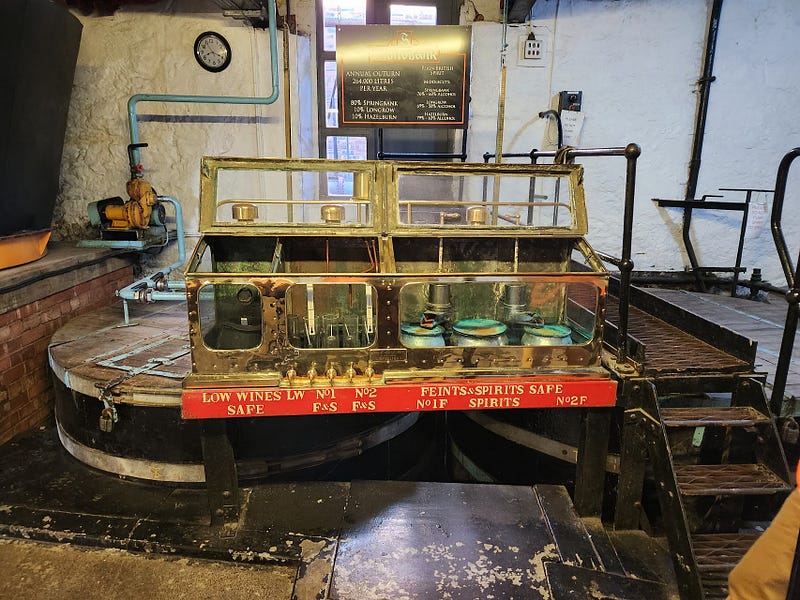
- From the condenser, it cools back into alcohol (at a higher percentage than the input liquid), and pours through a receiver or spirit safe , where it can be tested (e.g. for alcohol percentage and chemical composition) and the distiller can choose where to route it.
- The initial (heads) and final (tails) parts of a given distillation have harsher chemical composition, and are separated out, generally to be sent back into a previous phase of the distillation process.
- The rest (the hearts) are routed through to the next phase of the process — either the charger for the next still, or the vat that will be used for barreling.
Repeated distillation
There are different distillation regimes for the three whiskies made at Springbank, which differ in how many times the liquid is distilled and how much peat is used:
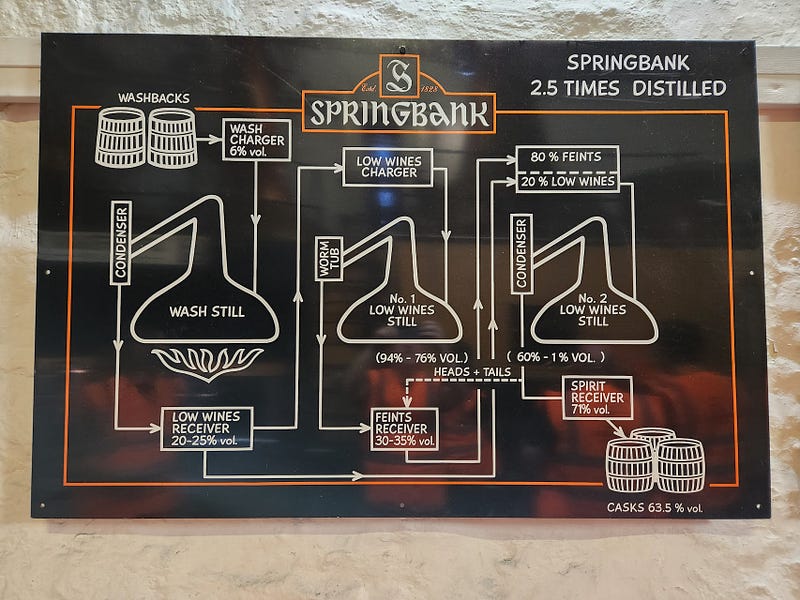 Springbank
is said to be distilled 2.5 times because some of the output of the
first still goes directly to the third still, while some goes to the
second still first.
Springbank
is said to be distilled 2.5 times because some of the output of the
first still goes directly to the third still, while some goes to the
second still first.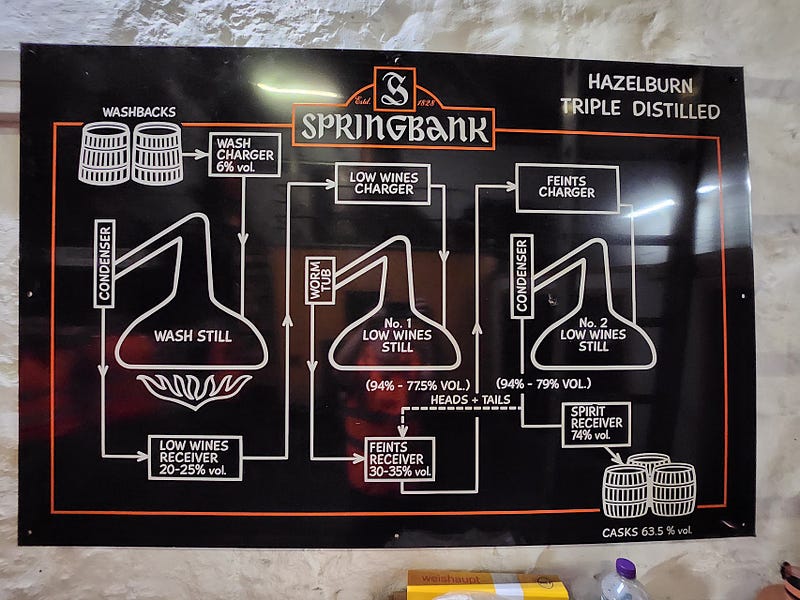 Hazelburn
is distilled three times.
Hazelburn
is distilled three times.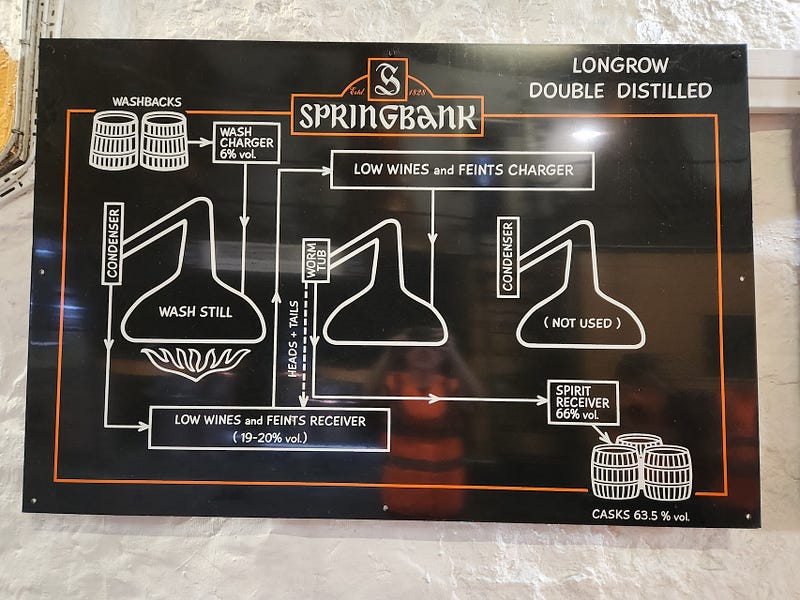 Longrow
is distilled twice.
Longrow
is distilled twice.
While these diagrams seem complicated, there is a pattern:
- The input fluid is stored in a tank called the charger.
- Fluid is moved from the charger into the still , to be heated to the boiling point of alcohol.
- Vapor from the still is captured into the condenser where it travels through pipe, cooling, and condensed down into a higher alcohol liquid,
- … which runs into a receiver or spirit safe , which is sort of a patch panel that allows the person operating the still to measure characteristics of the liquid and decide where it will go (e.g. to cut out heads and tails and feed the hearts into the next phase of distillation).
The three different whiskies (Longrow, Springbank, Hazelburn) show this pattern replicated 2, 2.5, and 3 times, with some variation in how inputs and outputs are connected. (Springbank whisky is the most complicated, because some of the liquid goes through the second still and some skips straight to the third still, hence “2.5 times.”)
When there are three stills, the output of the first still is the low wines , the output of the second is the feints , and the output of the third is the spirit.
Maturation
The spirit coming out of the final phase of the distillation process is called the new make. It’s not considered whisky, yet; Scotch whisky must be aged a minimum of 3 years (and other kinds of whisky have similar rules).
Scotch is matured in oak casks, some of which are new, and some of which have previously contained other spirits. Maturation comes from the chemical effects of the wood, which are both additive and subtractive : some character of the wood (and of previous spirits that might have been in the cask) is imparted into the spirit, but also, some chemicals in the spirit are pulled out into the wood. The additive and subtractive effects can continue working for many years. The amount of time spent in cask, and the types of cask, are also a key part of the “recipe” of a given whisky.
Cask storage
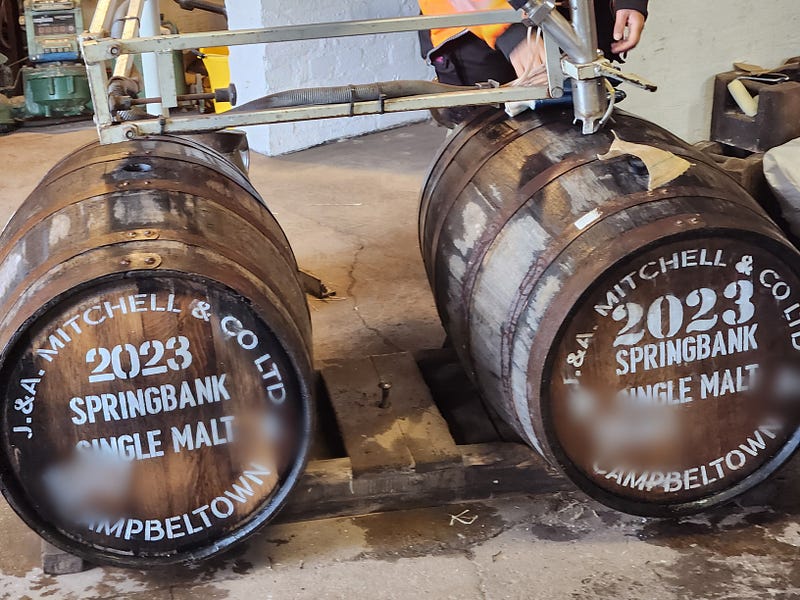
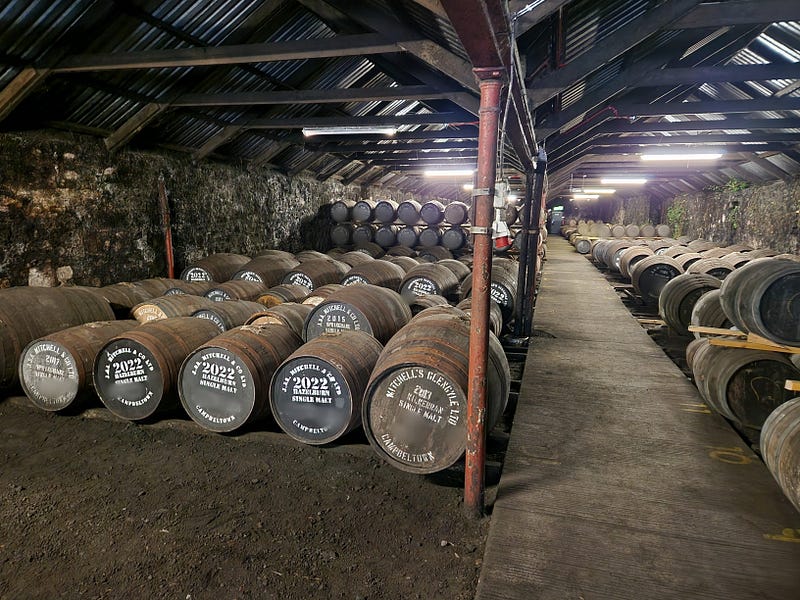
The spirit is then poured into casks. The most common cask for initial storage is an American-made barrel that previously contained bourbon, but sometimes barrels (or hogsheads or butts , vessels of larger sizes) that had different spirits in them are used — sherry, red wine, dessert wine, rum, etc. The casks are stored in a warehouse for a minimum of three years, usually longer. (Cask is the general term; barrel, hogshead, and butt refer to types of cask. But the phrase “barreling” is used for all sizes of cask.)
In a dunnage warehouse , casks are stacked directly on one another. In a racking warehouse , there are pre-existing racks/shelves to stand them on.
Bottling
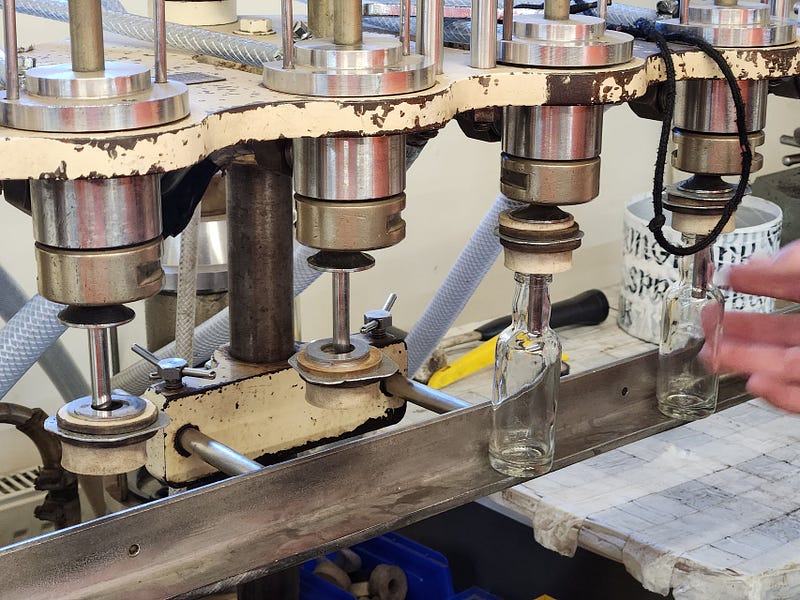
When it comes time to transfer the contents of a barrel out, it’s emptied into a vat at the bottling plant. Here, it might be combined with the contents of another barrel, of either the same or or different type, and the vat can then be emptied either into other casks (e.g. to finish it in something that might be too intense had it been used for the entire maturation) or into bottles.
Consumption
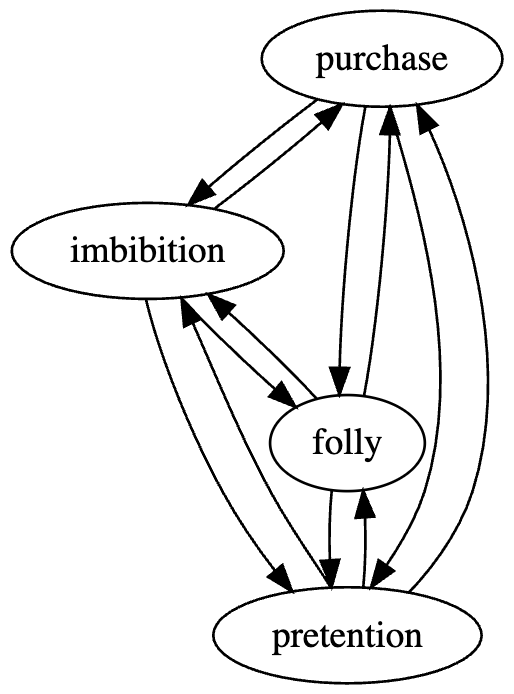
The final phase consists of four intermingled actions, which can be performed repeatedly and in any order:
- Purchase
- Imbibe
- Pretentiously employ terms like “tannic,” “peaty,” “pickle relish,” “vanillin,” “earthy,” or “smarmy”
- Make unwise decisions